


Bishops and Barbershops
- Charlie Bonner
- May 30, 2018
- 6 min read

Montgomery, Alabama – Selma, Alabama
Playlist: Peter, Paul and Mary
Edmund Pettus, for whom the iconic bridge in Selma is named, was a United States Senator representing Alabama and a Grand Dragon of the Ku Klux Klan. The backdrop that became synonymous with the struggle for voting rights is named after a Klansman—Alabama, much like America, is riddled with contradiction.
“The KKK wants us to remember, and we can remember, but that that ain’t nothing to be proud of. Lynching women and children ain’t nothing to be proud of,” Gloria tells me at her souvenir shop at the foot of the bridge.“Seems like everything they naming is after the KKK…it’s ignorant,” she shakes her head as she straightens up the small store. T-shirts and posters are commemorating Bloody Sunday and the 50th-anniversary march; there are trinkets, homemade jewelry, and dashikis. “There is still a lot of prejudice…like I tell my kids, you gotta study hard. They don’t do it with the whip anymore. They do it with the pencil. You have to know who you are. Don’t let anyone define you.” Gloria was raised in Selma and watched it change, watched the annual jubilee march across the bridge grow, watched the first black president join in that march 50 years after its inception. On the current state of politics, “it’s gotten crazier,” she tells me, those same KKK members are lurk in the shadows of Alabama, “they just keep it on the DL, they keep it on the Down Low.”
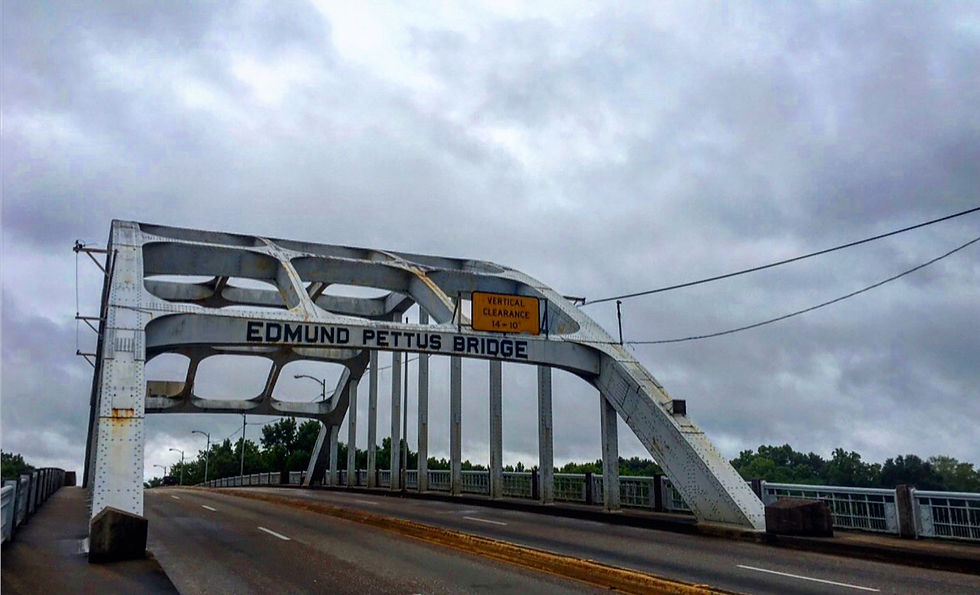
I visit the small monuments on this side of the bridge, noting the tomb of the unknown black Confederate soldier and the unknown slave, the plaque for the victims of Selma’s racial terror lynching’s and celebrations of Congressman John Lewis along murals of those who marched. It is a crowded space of commemoration at the foot of the Klansman’s bridge. I walked across the bridge alone, the skies grey with the coming rain. The dullness of the sky seems to resemble the stark contrast of the black and white photos that define my own memory of Bloody Sunday. Men and women shed blood on this very road to bring the union closer to perfection. It is unnerving and inspiring to cross in their footsteps.

“We don’t really talk about politics and religion,” one visitor center employees tell me, “don’t want to cause any problems.” Many of the locals are focused on the local elections that will take place June 5th, but “people don’t get out there like they used to,” one of them tells me about the candidates. “They think everyone is on Facebook. That everyone is on their phone,” she continues. “There is no ground game anymore,” the other responds. They also tell me that folks here, despite the localities role in the expansion of voting rights, aren’t any more involved than the rest of us. I am shocked by this, I shouldn’t be, but I am. At this end of the town’s main street, there is a visual reminder of the struggle for those voting rights, and yet, no change. If this doesn’t change voting habits, what does?
Political placards cover the front of one of the local barbershops. I walk in, notably out of place, and start asking them about the state of politics, what I received was one the harshest criticisms of President Trump I have ever heard. “You need to hang his ass up in a tree,” one barber says, “he’s messing everything up.” The other barber disagrees, “that’s too easy, I want him to have a chance. Put him on the front lines.” The old man sitting in the chair rebukes“He’s dodged before.” What is unfolding before me is a full-fledged debate over the best way to get rid of the sitting President, never missing a step in trimming their customers' hair.
The conversation turns to war, and one jokingly suggests drafting the NRA for the war, “You love guns so much. You so patriotic. You oughta be glad to fucking fight.” The others nod in agreement. Local politics again is at the focus,“they all crooked as hell,” the more colorful barber adds to the conversation. They note that many times, outside groups will flood elections with candidates to split the vote, normally along racial lines. And the Mayor, no one likes the current mayor, “The Mayor ain't doing shit. He’s homosexual, he chasing penises around here, he wants to see them penis.” (I can’t tell whether he’s comfortable saying these things because I’m passing as straight in Alabama or if I’m being provoked, I laugh uncomfortably with my head down and take furious notes.)
On voting, Ooh, that’s a must. You gotta vote. A lot of people say it doesn’t matter, but you gotta vote.” Noting those who perished in the fight for voting rights. On the Trump voters themselves, “everything they got, they deserved. They voted for him.” A discussion begins on why it is that Trump won in the first place, “some men just won’t be governed by a female,” regardless of whether they liked Trump or not. They note the similarities in neighboring Georgia’s gubernatorial election with Stacey Abrams.
“Why don’t Trump come to Jubilee,” one of them poses, referring to the annual march remembrance, “Probably cause we’d kill him,” the other responds. “And, he’s a fucking racist. He don’t give a fuck about a nigga.”
Slightly upset I wasn’t actually getting my hair cut, the gentlemen of the barbershop say their goodbyes and suggest I stop by the local radio station that always talks politics. I knock on the door of WBDZ 105.3 and meet Bishop Franklin Fortier, one the radio hosts and a candidate for Probate Judge in Dallas County where Selma sits. “I just released a song called Demonocracy, do you know what a Demonocracy is? A Demonocracy is a government run by demons, with ill will for the people at large.” Referencing the spread of things such as police brutality and the influence of big money in politics, Fortier believes that those at the top no longer care about the people they were elected to serve. “There is a rationalization and justification of the mistreatment of people unless you’re a big business with a whole lot of money…We don’t have a democracy,” he insists. He provides as a local example they were talking about on the radio just this morning, a 24-year-old unarmed black man was believed to have a weapon, despite that not being true, when he ran, attack dogs were sent on him. The damage to his legs is so severe that it is unclear whether or not he will be able to walk again. (I am reminded of the statues of attack dogs snarling in the Birmingham park.) Police brutality “doesn’t seem to be isolated.”
The “bishop of the black belt,” uses his platform to encourage people to get involved, even though people don’t think the government is working for them. “We have a lot of conversations about politics, about Trump,” noting that they have coined the term “negative 45” to refer to the President. “We have to challenge government…we don’t want to be victims to a process that has gone wrong,” he tells me. “Everybody should be saying no right now, a resounding no,” He is encouraged by individuals like Tom Steyer who are willing to put in millions of dollars to impeach the President, “don’t you think we could better use that money elsewhere?” I ask. “Our democracy is worth it,” he insists. “At what point are we going to get engaged, “he presses, asking “how many people have to be abused before we're concerned. We need another movement.” What’s going on in politics can be overwhelming to people, “ it's unreal, but for a lot of people its surreal,” he notes, “we never thought anything like this would happen.”
The local politics are just as messy as those in Washington. In a community more than 70% African American, five out of the six countywide positions are white. There has never been a black sheriff or probate judge in the 200-year history of the county. The bishop, like the men of the barbershop, notes that outside influences run puppet candidates to split the black vote. That has to change, he insists, it can’t be about “the nice guy who gave you a free ice cream.”
“People have romantic ideas of democracy, but we need fighters, relentless, skilled fighters. To me, that represents an opportunity…Politics isn’t about the nice guys; it’s about those who can fight.”


I drive back to Montgomery with the windows down on the same road that protestors marched to the state capital where Dr. King would proclaim, “Let us realize the arc of the moral universe is long, but it bends toward justice.” The fascinating thing about Montgomery in the modern age is that its troubling past is compounded with its marks of progress. The Rosa Parks Library sits on Lee Street; the Southern Poverty Law center sits two blocks from the first white house of the Confederacy; Dr. King’s church is only blocks from Jefferson Davis’s church; an all-black high school bands practices in front of Jefferson Davis High School. The capital that was used to divide a nation would be the backdrop to King’s efforts to bring it back together. Alabama is riddeled with contradcition.
Comments